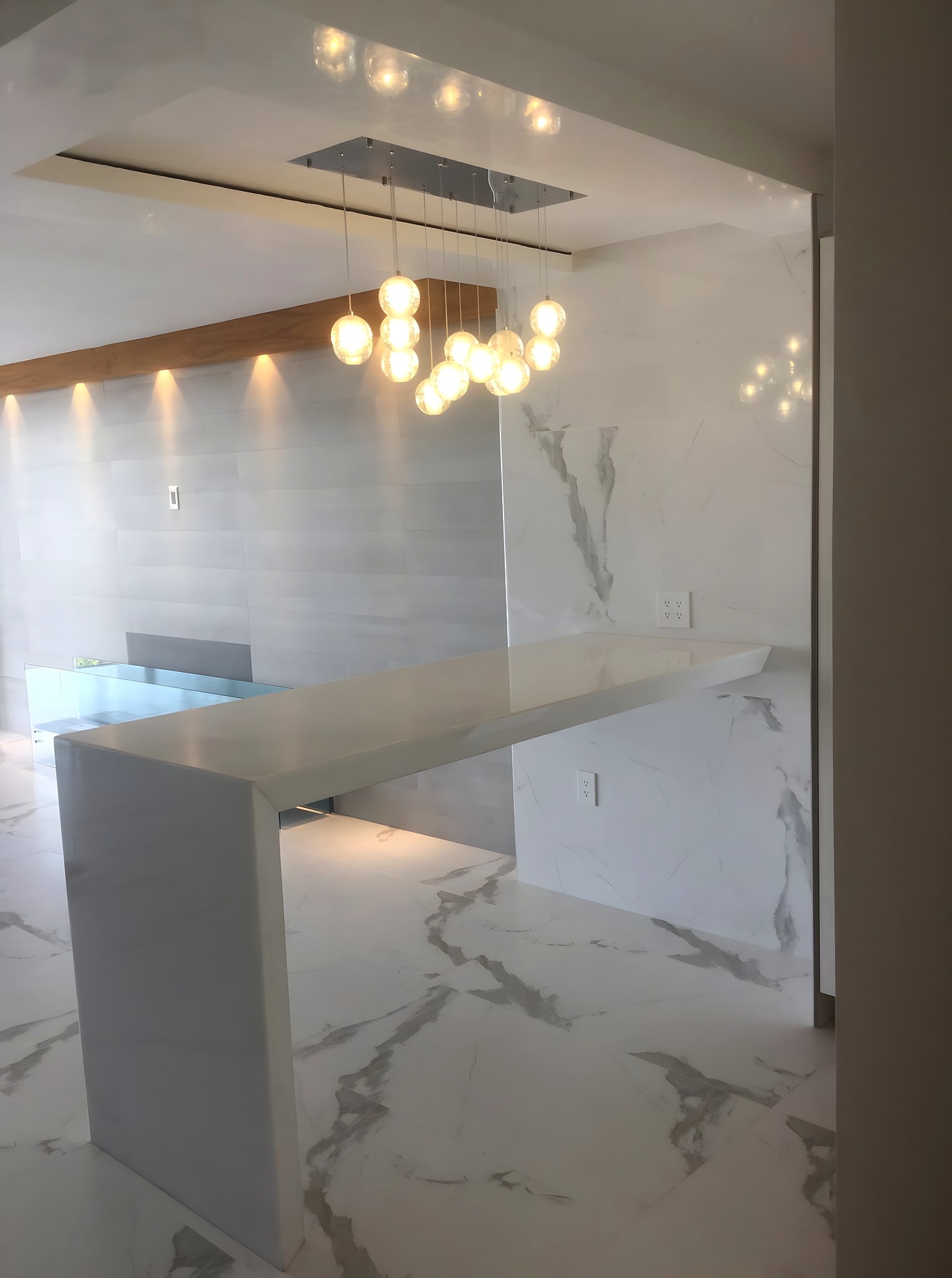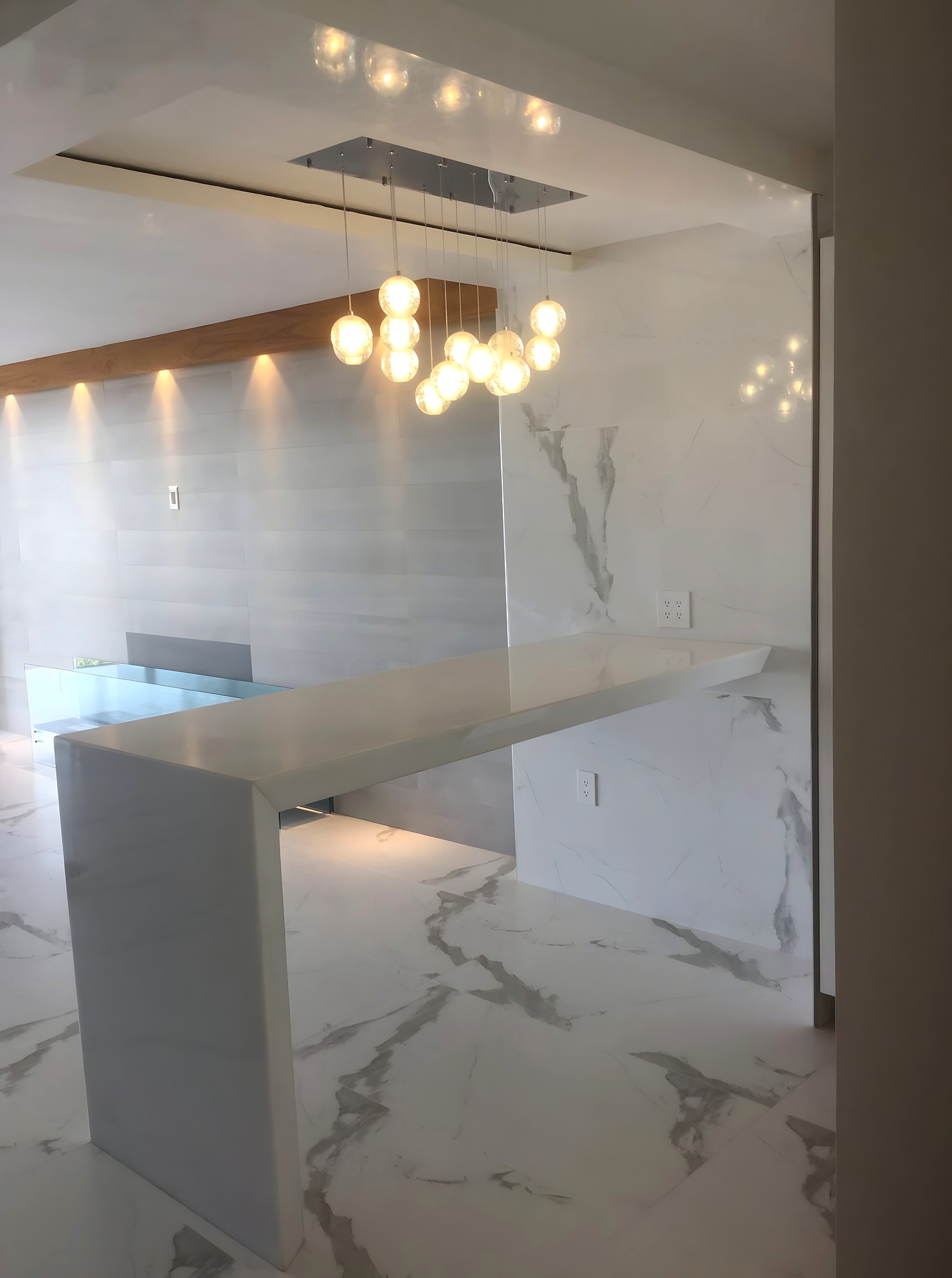
Choosing the right countertop edge profiles is one of the most overlooked decisions in a kitchen renovation — yet it has a significant impact on the finished look, the feel of the space, and even the safety and durability of your countertops. The edge profile you select defines the visual weight of your countertop, influences how the stone interacts with light, and affects how the surface meets your cabinetry below.
At Becca Proworks, we fabricate every edge profile in-house at our Hialeah facility using precision CNC machinery and expert hand-finishing. Over 25 years and more than 1,000 projects across South Florida, we have helped homeowners select edge profiles that elevate their kitchens from functional to extraordinary. This guide walks you through the most popular options and when each one works best.
Straight (Eased) Edge
The straight edge — also called an eased edge — is the most common and versatile countertop edge profile. It features a flat, squared-off edge with just the sharp corners slightly rounded (eased) to prevent chipping and eliminate any sharpness that could be uncomfortable or dangerous.
When to Choose a Straight Edge
- Modern and contemporary kitchens — the clean, geometric lines of a straight edge complement minimalist cabinetry, flat-panel doors, and sleek hardware
- Tight budgets — the straight edge requires the least fabrication time, making it the most economical option
- Thick-slab looks — when paired with a mitered edge (discussed below), a straight edge creates the appearance of a thick, monolithic slab
- Busy households — the simplicity of the profile means fewer crevices where crumbs and debris can collect
Design Notes
A straight edge lets the stone speak for itself. If you have selected a granite or quartzite with dramatic veining or movement, a simple eased edge keeps the focus on the stone rather than competing with an ornate profile. This is one of the reasons it pairs so well with the bold veining and warm tones trending in 2026 kitchen design.
Bullnose Edge
The bullnose edge features a fully rounded profile — the top and bottom edges curve into a smooth, continuous half-circle. A half bullnose rounds only the top edge, leaving the bottom flat.
Full Bullnose
A full bullnose creates a soft, pillow-like edge with no sharp angles whatsoever. It has a classic, timeless appearance that works well in both traditional and transitional kitchens.
Best for:
- Families with young children — the completely rounded profile eliminates any hard corners at child height
- Bathroom vanities — the soft edge feels comfortable when leaning against the counter
- Traditional and Mediterranean-style kitchens — the rounded profile complements arched doorways, raised-panel cabinetry, and ornamental details common in South Florida's Mediterranean-influenced homes
Half Bullnose (Demi Bullnose)
A half bullnose rounds the top edge into a quarter circle while keeping the bottom edge square. It offers a softer look than a straight edge without the full roundness of a bullnose.
Best for:
- Transitional kitchens — it bridges the gap between modern and traditional
- Homeowners who want some softness without committing to a fully rounded look
- Virtually any stone type — the half bullnose is flattering on granite, quartzite, quartz, and marble alike
Beveled Edge
A beveled edge cuts the top corner of the countertop at an angle — typically 45 degrees — creating a flat, angled surface along the edge before meeting the vertical face. The bevel is usually narrow, about a quarter inch to half an inch wide.
When to Choose a Beveled Edge
- Contemporary kitchens with a slight design detail — the bevel adds a subtle visual element without being ornate
- Kitchens with under-cabinet lighting — the angled surface catches light beautifully, creating a thin line of highlight along the countertop perimeter
- Dark-colored stones — a bevel on a polished black granite or dark quartzite creates a striking light-catching detail
Design Notes
The beveled edge is understated and architectural. It adds just enough interest to prevent a countertop from looking plain, while maintaining the clean lines that contemporary design demands. In South Florida's modern coastal homes, we frequently pair beveled edges with leathered or honed finishes for a sophisticated, layered look.
You can also combine a bevel with other profiles — for example, a beveled edge on the countertop perimeter with a different profile on the island. Mixing profiles within a single kitchen is a design technique that can create visual hierarchy and differentiation between zones.
Ogee Edge
The ogee is one of the most elegant and decorative standard edge profiles. It features an S-shaped curve — an inward curve at the top transitioning to an outward curve below — creating a profile with classical proportions and refined detail.
When to Choose an Ogee Edge
- Traditional, formal, or luxury kitchens — the ogee is at home in spaces with crown molding, ornate cabinetry, and high-end finishes
- Statement islands — using an ogee on the island while keeping a simpler profile on the perimeter countertops draws attention to the island as the focal point
- Marble and light-colored quartzite — the curves of an ogee create beautiful shadow lines that enhance the depth and dimension of lighter stones
Considerations
The ogee profile has more surface area than simpler edges, which means:
- It requires more careful cleaning — the curves can collect residue
- It takes more fabrication time to produce
- It can chip more easily than flat profiles if struck, so it is less ideal for high-traffic areas or homes with active young children
Despite these considerations, a well-executed ogee on a beautiful slab of natural stone is one of the most visually stunning details in kitchen design. The craftsmanship required to produce a flawless ogee is one of the things that sets experienced fabricators apart.
Waterfall Edge
A waterfall edge is not a traditional edge profile in the usual sense — it refers to a design where the countertop material continues vertically down the side of a cabinet or island to the floor. The result is a continuous cascade of stone that makes the island look like a solid block of material.
When to Choose a Waterfall Edge
- Modern and contemporary kitchens — the waterfall edge is a hallmark of contemporary kitchen design
- Showcasing dramatic stone — if you have selected a slab with bold veining, a waterfall edge allows that veining to flow from the horizontal surface down to the floor, creating a continuous visual story
- Creating visual anchoring — a waterfall island becomes the unmistakable centerpiece of the kitchen, grounding the entire space
- Concealing the island structure — the stone panel hides the cabinetry underneath, creating a cleaner, more monolithic appearance
Waterfall Edge Execution
A waterfall edge requires exceptional fabrication skill. The stone must be precisely cut so that the veining pattern aligns where the horizontal countertop meets the vertical panel. This vein matching — particularly at the 90-degree turn — is one of the most challenging aspects of countertop fabrication.
At Becca Proworks, we use digital templating and CNC cutting to achieve precise vein continuity on waterfall installations. The seam should be nearly invisible when executed properly. You can see examples of our waterfall edge work in our project gallery.
For more on how waterfall edges are trending in current kitchen design, see our article on kitchen countertop trends for 2026.
Mitered Edge
A mitered edge joins two pieces of stone at a 45-degree angle to create the appearance of a much thicker countertop. Standard countertop slabs are typically two or three centimeters thick. A mitered edge can make the countertop appear four, six, or even eight inches thick — giving it a substantial, luxurious presence.
When to Choose a Mitered Edge
- Modern luxury kitchens — the thick-slab look is a current design favorite, and a mitered edge achieves it without the extreme weight of an actual thick slab
- Waterfall combinations — mitered edges are often combined with waterfall sides to create an even more dramatic, monolithic appearance
- Uniform surfaces — when you want the countertop to look like a solid, continuous block of stone
- Commercial and high-end residential projects — the mitered edge conveys premium quality and meticulous craftsmanship
Mitered Edge Execution
Like waterfall edges, mitered edges demand precision. The two pieces must be cut at exactly 45 degrees, and the joint must be bonded seamlessly with color-matched adhesive. When done correctly, the seam disappears and the countertop appears to be a single, impossibly thick piece of stone.
For a comprehensive look at mitered edges — including design inspiration and fabrication details — read our dedicated mitered edge countertops guide.
Choosing the Right Edge for Your Stone
Different stones lend themselves to different edge profiles. Here are some general guidelines:
Granite
Granite's density and hardness make it suitable for virtually any edge profile. It holds intricate details like the ogee well and is less prone to chipping on detailed profiles than softer stones. Leathered granite with a straight or beveled edge is a particularly striking combination.
Quartzite
Quartzite is extremely hard and can support any profile. Its dramatic veining looks especially stunning with waterfall and mitered edges, where the patterns continue across surfaces. For a comparison of quartzite with other materials, see our quartz vs quartzite guide.
Engineered Quartz
Quartz handles all standard edge profiles well. Because it is manufactured, the color and pattern will be consistent through the edge, which can be an advantage for detailed profiles where the stone's cross-section is visible.
Marble
Marble is softer than granite and quartzite, which means ornate edges like the ogee are more susceptible to chipping over time. For marble countertops, simpler profiles like eased, half bullnose, or beveled tend to be more practical for long-term durability. See our marble care guide for more on maintaining marble in South Florida.
Mixing Edge Profiles in One Kitchen
A design technique we frequently recommend is using different edge profiles in different zones of the kitchen:
- Island: A more detailed or dramatic profile (waterfall, mitered, or ogee) to establish the island as the centerpiece
- Perimeter countertops: A simpler profile (eased, half bullnose, or beveled) that complements the island without competing with it
- Bathroom vanities: A softer profile (full bullnose or half bullnose) for comfort and safety
This approach creates visual hierarchy — it tells the eye where to focus and adds layers of design interest without making the space feel busy.
See Every Edge Profile in Person
Photographs and descriptions can only convey so much. To truly appreciate the difference between edge profiles, you need to see and feel them in person. At our Hialeah facility, we have samples of every standard edge profile in multiple stone types so you can compare them side by side.
We also keep finished remnants from past projects that show how different profiles look on full-scale installations — not just small samples.
Let Becca Proworks Help You Decide
Choosing an edge profile is one of many decisions that go into creating a countertop you will love for years. With over 25 years of experience serving Hialeah, Miami, and all of South Florida, our team has the expertise to guide you through every detail — from stone selection to edge profile to finish and installation.
Request your free estimate or call (786) 468-5078 to schedule a consultation. We will help you choose the edge profile that perfectly matches your kitchen's style, your stone selection, and your lifestyle.