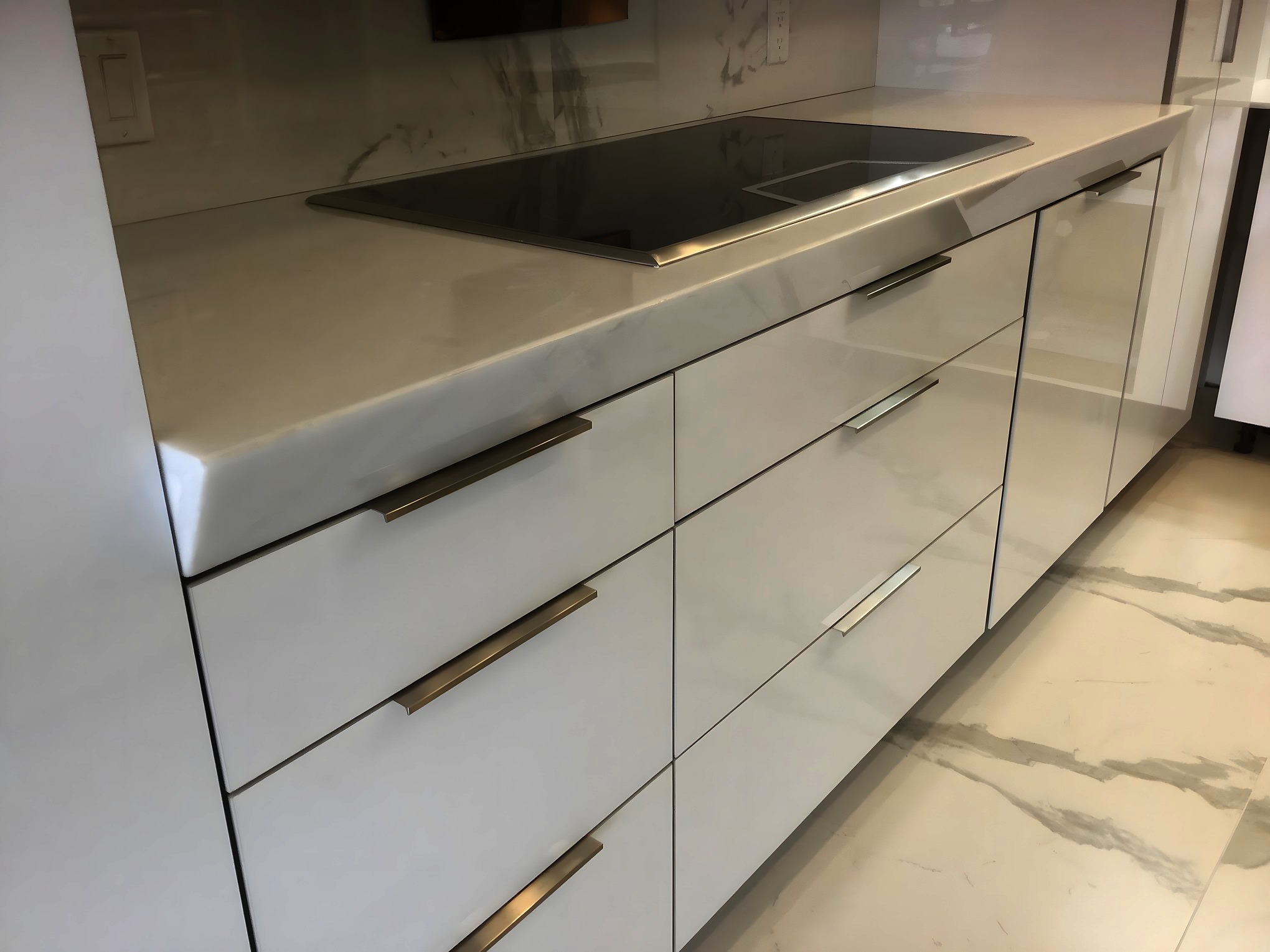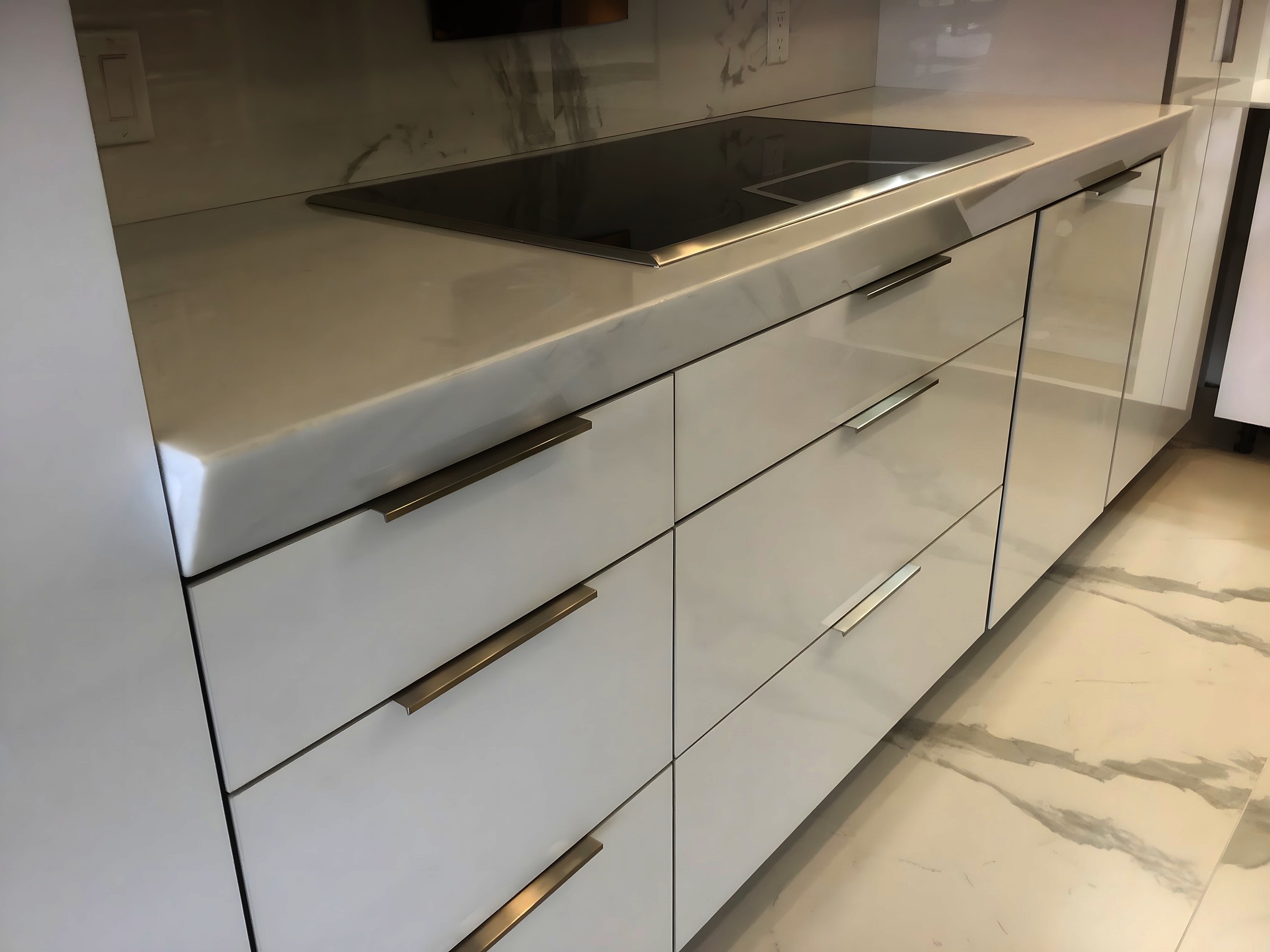
The quartz vs quartzite countertops question is one of the most common conversations we have with homeowners visiting our showroom in Hialeah. Despite sounding nearly identical, these two materials are fundamentally different in composition, performance, maintenance requirements, and ideal use cases. Choosing the wrong one can mean years of frustration — or worse, a costly replacement.
At Becca Proworks, we have fabricated and installed both quartz and quartzite countertops across South Florida for over 25 years. This guide breaks down everything you need to know so you can make a confident, informed decision for your home.
The Fundamental Difference: Engineered vs Natural
The simplest way to understand the quartz vs quartzite distinction is this: quartz is manufactured in a factory, quartzite is quarried from the earth.
Engineered Quartz
Engineered quartz countertops are made by combining approximately 90 to 94 percent ground natural quartz crystals with 6 to 10 percent polymer resins, pigments, and other binding agents. The mixture is compressed under extreme pressure and heat to create uniform slabs.
Major brands include Cambria, Caesarstone, Silestone, LG Viatera, and MSI Q Quartz. Because the manufacturing process is controlled, quartz countertops come in highly consistent colors and patterns. If you pick a sample at the showroom, the slab you receive will match it closely.
Natural Quartzite
Quartzite is a natural metamorphic rock that begins as sandstone. Over millions of years, intense heat and pressure deep within the earth fuse the sand grains together into an extremely hard, dense stone. Each slab is unique — the veining patterns, color variations, and mineral inclusions are one of a kind.
Popular quartzite varieties include Taj Mahal, Super White, Calacatta, Mont Blanc, Sea Pearl, and Madre Perla. These stones are quarried primarily in Brazil, though deposits exist worldwide.
Appearance: Consistency vs Character
This is often the deciding factor for homeowners, and it comes down to personal preference.
Quartz Appearance
Quartz offers remarkable design consistency. Manufacturers can produce slabs that mimic the look of marble, concrete, granite, or even solid colors with no veining at all. Because the pigments and patterns are engineered, you get predictable results.
Modern quartz products have become increasingly sophisticated in replicating the look of natural Calacatta or Carrara marble, with realistic veining and warm undertones. For homeowners who want a specific aesthetic without the variability of natural stone, quartz delivers.
Quartzite Appearance
Quartzite has the movement, depth, and organic beauty that only nature can produce. The veining in a Taj Mahal quartzite or the translucent layers in a backlit Cristallo quartzite cannot be replicated by any factory.
However, natural stone means natural variation. The sample you see at the showroom may differ from the full slab. This is why we always recommend visiting our facility to hand-select your actual slab — what we call the "slab selection" experience. The variation is part of quartzite's appeal, but you need to see your specific slab before committing.
If you are comparing the look of natural stones more broadly, our guide on quartz vs granite countertops covers another common comparison worth considering.
Durability: How Each Material Holds Up
Both materials are durable, but they handle stress differently.
Hardness and Scratch Resistance
Quartzite is one of the hardest natural stones available, rating a 7 on the Mohs hardness scale. It is harder than granite (which ranges from 6 to 7) and significantly harder than marble (3 to 5). You would have a difficult time scratching quartzite with a kitchen knife.
Engineered quartz is also highly scratch-resistant, though slightly softer than quartzite in most cases. For everyday kitchen use, both materials resist scratching well. The practical difference is minimal unless you are regularly cutting directly on the surface, which we never recommend regardless of material.
Impact Resistance
Quartz has a slight edge in impact resistance because the resin binders give the material some flexibility. Natural quartzite, being a rigid crystalline stone, is more prone to chipping at the edges if struck hard. In practice, neither material is fragile — this only matters in cases of significant impact, like dropping a heavy cast iron pan directly on a corner.
Heat Resistance
This is where the two materials diverge significantly.
Quartzite handles heat beautifully. As a natural stone forged under extreme geological heat and pressure, it is unbothered by hot pans, baking sheets, or anything else you might set down in a kitchen. You can place a hot pot directly on quartzite without any risk of damage.
Quartz is vulnerable to heat. The polymer resins in engineered quartz can scorch, discolor, or crack when exposed to temperatures above roughly 300 degrees Fahrenheit. Setting a hot pan directly on a quartz countertop can leave a permanent burn mark. You must always use trivets or hot pads with quartz surfaces.
For South Florida homeowners who love to cook — and especially those considering an outdoor kitchen — this distinction is critical.
Maintenance: Sealing, Cleaning, and Long-Term Care
Quartz Maintenance
One of the biggest selling points of engineered quartz is that it requires virtually no maintenance. The resin binders make the surface non-porous, which means:
- No sealing required — ever.
- Stain resistant — liquids like wine, coffee, and citrus juice sit on the surface without penetrating.
- Easy cleaning — warm water and mild soap are all you need for daily care.
This low-maintenance profile makes quartz particularly appealing for busy families and rental properties.
Quartzite Maintenance
Quartzite is a natural stone with varying degrees of porosity depending on the specific variety. Most quartzite countertops require:
- Periodic sealing — typically once every one to two years, though some varieties need it more frequently. In South Florida's humid climate, we generally recommend annual sealing. Read our guide on caring for marble countertops in Florida humidity for maintenance principles that also apply to other natural stones.
- Prompt spill cleanup — while sealed quartzite is quite stain-resistant, acidic substances like lemon juice or red wine should be wiped up promptly rather than left to sit.
- pH-neutral cleaners — avoid harsh chemicals, vinegar, or abrasive cleaners that can degrade the sealer.
The maintenance difference is real but often overstated. Sealing a countertop once a year takes about fifteen minutes. For many homeowners, the beauty of natural quartzite is well worth that minimal effort.
UV and Outdoor Considerations in South Florida
This is a critical distinction for South Florida homeowners.
Quartz cannot be used outdoors. The polymer resins degrade under UV exposure, causing yellowing and discoloration. Every major manufacturer excludes outdoor use from their warranty.
Quartzite is fully UV stable. As a natural stone with no synthetic components, quartzite performs beautifully in outdoor applications — patios, outdoor kitchens, pool surrounds, and more.
If any part of your countertop will be exposed to direct sunlight — even through a large window or sliding glass door — this is worth considering. We have seen quartz countertops near floor-to-ceiling windows in Miami condos develop fading on the sun-exposed section over time.
When to Choose Quartz
Quartz is the right choice when you want:
- Zero maintenance — no sealing, no special cleaners, no annual upkeep
- Consistent color and pattern — you know exactly what you are getting
- Maximum stain resistance — ideal for homes with young children or heavy kitchen use
- A specific manufactured aesthetic — solid colors, subtle patterns, or marble-look designs
- Indoor use only — kitchens, bathrooms, laundry rooms
Quartz works exceptionally well in kitchens across Hialeah and Miami where homeowners want a clean, modern look with minimal maintenance demands.
When to Choose Quartzite
Quartzite is the right choice when you want:
- One-of-a-kind natural beauty — no two slabs are the same
- Superior heat resistance — hot pans directly on the surface without worry
- Outdoor capability — UV stable for outdoor kitchens and patios
- Extreme hardness — the hardest commonly available countertop stone
- A luxury natural stone — the prestige and character of a material formed over millions of years
Quartzite is particularly popular in South Florida's coastal-modern and transitional home designs, where the organic veining patterns complement the natural light and open floor plans that define the region's architecture.
Common Myths We Hear at Our Showroom
"Quartzite is just a type of quartz." False. They are completely unrelated materials that happen to share a root word.
"Quartz is indestructible." False. Quartz can be scorched by heat, damaged by UV light, and chipped by heavy impacts. It is durable, but not invincible.
"Quartzite stains easily." Misleading. A properly sealed quartzite countertop is highly stain-resistant. The key is maintaining the sealer on schedule.
"You can use quartz outdoors if it is covered." Risky. Even covered outdoor areas in South Florida receive reflected UV light. We do not recommend quartz for any outdoor application.
"Quartzite and marble are the same thing." False. While some quartzites are marketed with marble-sounding names, quartzite is dramatically harder and more durable than marble.
Making Your Decision
The best way to choose between quartz and quartzite is to see and feel both materials in person. Visit our stone selection gallery to explore the full range of options we carry, or stop by our Hialeah facility where you can view full slabs and compare materials side by side.
Here is a quick reference to summarize the comparison:
| Feature | Quartz | Quartzite |
|---|---|---|
| Origin | Engineered (factory) | Natural (quarried) |
| Hardness | High | Very high (Mohs 7) |
| Heat resistance | Low (use trivets) | Excellent |
| Sealing required | No | Yes (annually) |
| UV resistant | No | Yes |
| Outdoor use | No | Yes |
| Pattern consistency | High | Varies by slab |
| Maintenance level | Very low | Low to moderate |
Let Us Help You Choose
With over 1,000 countertop projects completed across South Florida, the Becca Proworks team has the experience to help you navigate this decision based on your specific kitchen, lifestyle, and design goals. Whether you are leaning toward quartz or quartzite, we will walk you through the options and make sure you end up with a surface you love for years to come.
Schedule your free estimate or call (786) 468-5078 to get started. We serve homeowners throughout Hialeah, Miami, and all of South Florida.