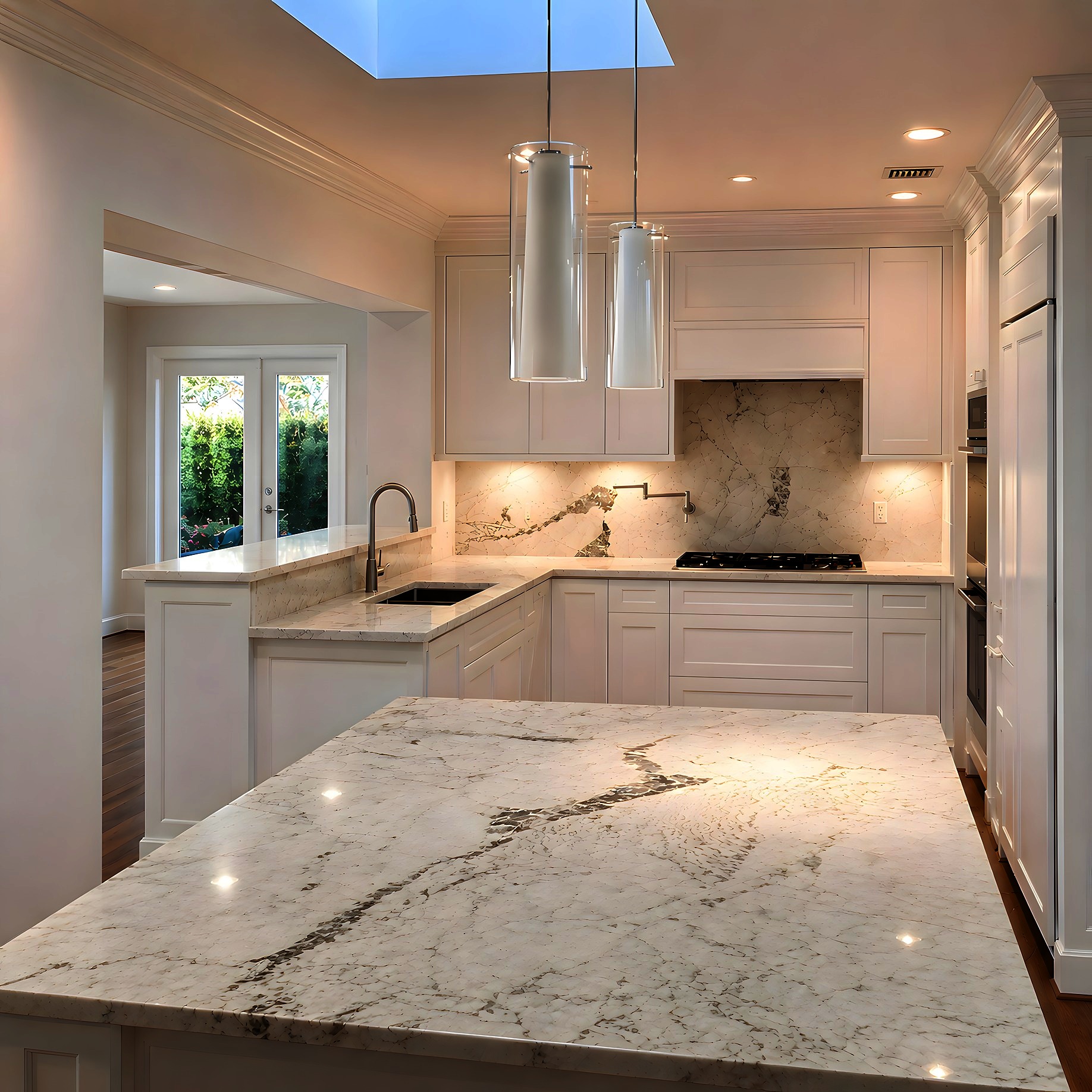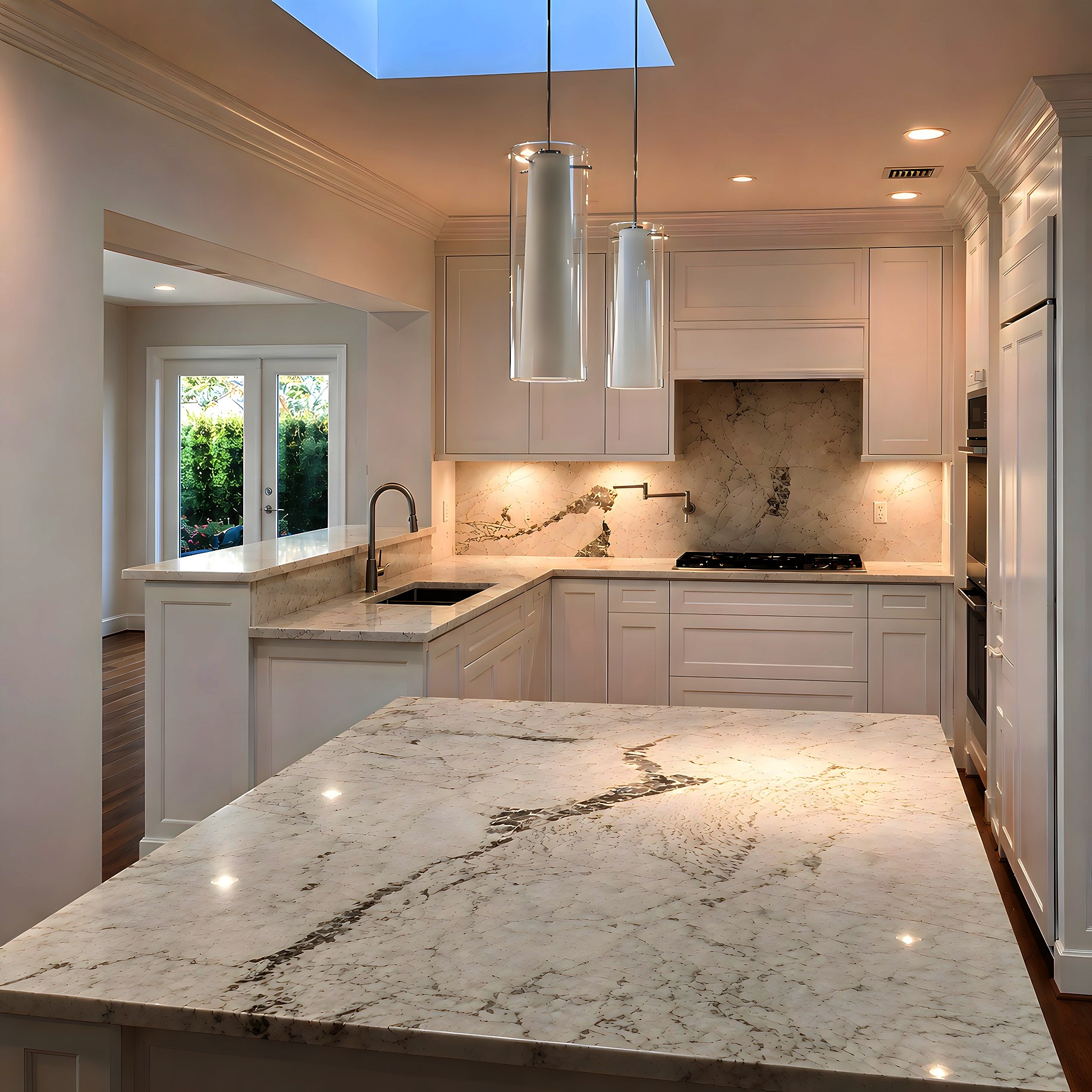
If you're remodeling your kitchen or building a new home in South Florida, you've probably narrowed your countertop choice down to two materials: quartz or granite. Both are beautiful, both are durable, and both are popular for good reason — but they're very different stones, and the right choice depends on your lifestyle, your design goals, and how much maintenance you're willing to do.
After fabricating and installing over 1,000 stone countertops across Miami, Hialeah, Fort Lauderdale, and the rest of South Florida for 25+ years, here's our honest take.
The Quick Answer
Choose quartz if you want a low-maintenance, modern, consistent look with minimal upkeep, and you don't mind that it's an engineered (not natural) stone.
Choose granite if you want a one-of-a-kind natural stone with unique character, you appreciate organic patterns, and you're okay with sealing it once a year.
Both are excellent choices. Neither is "better" — they're just different.
What Are They, Really?
Granite
Granite is a 100% natural stone quarried from the earth in massive blocks, then cut into slabs. Every piece is unique. The patterns, colors, and veining you see formed over millions of years — no two slabs are exactly alike.
Quartz
Quartz countertops are engineered. They're made of about 90-95% crushed natural quartz mineral, mixed with resins, polymers, and pigments, then formed into slabs under heat and pressure. Brands like Cambria, Caesarstone, Silestone, and MSI Q produce quartz.
The result is a stone that looks natural but has the consistency of an engineered product — every square inch matches the next.
Looks: Natural Character vs Consistent Design
Granite is the winner if you love organic, one-of-a-kind patterns. Each slab has its own movement, mineral inclusions, and color variations. When you visit our warehouse in Hialeah and walk between slabs, you'll see no two are the same — and that's the point.
Quartz is the winner if you want predictable, repeatable design. Brands have engineered quartz to mimic everything from Calacatta marble to Carrara marble to solid colors that don't exist in nature. If you're decorating a modern kitchen and want a clean, uniform white surface, quartz delivers that without surprises.
For South Florida homes, we see homeowners gravitate toward:
- Quartz for modern condos in Brickell, Aventura, and Miami Beach
- Granite for traditional homes in Coral Gables, Pinecrest, and the Gables
Durability: Both Are Tough
Both materials are extremely durable. Both can take daily kitchen use, hot pans, knives, and decades of family life. But there are nuances.
Granite is harder than quartz — almost as hard as diamond. It's heat resistant up to about 1,200°F. You can set a hot pan directly on granite with no damage.
Quartz is slightly less heat resistant — typically rated up to about 300°F. Hotter than that and the resin binders can scorch or discolor. Always use a trivet for hot pans on quartz.
Both materials resist scratches from normal use. Both can chip on a sharp corner if you slam a heavy pot down. We've seen far more chipped granite from impact than chipped quartz.
Stains: Quartz Wins
This is where quartz pulls ahead for most homeowners.
Quartz is non-porous. Spills sit on the surface and wipe away. Wine, coffee, oil, lemon juice, tomato sauce — none of it will stain quartz. You don't need to worry.
Granite is porous. It needs to be sealed regularly (typically once a year) to resist stains. If you spill red wine on unsealed granite and leave it overnight, it can leave a mark. Sealed granite is highly stain resistant, but you have to remember to reseal it.
For families with kids who spill, or anyone who hates the idea of "babying" a countertop, quartz is the practical winner.
Maintenance: Quartz Wins (Again)
Quartz maintenance: Wipe with soap and water. That's it. No sealing, no special cleaners, no waxing.
Granite maintenance: Daily cleaning with mild soap is fine. But you'll need to re-seal once a year (we can do it for you, or you can buy a kit at any home improvement store and do it yourself in about 15 minutes).
If "no maintenance" is a hard requirement, choose quartz.
Price: It's a Wash
People often assume granite is cheaper than quartz, or vice versa. The reality is they overlap heavily.
Entry-level granite: Often less expensive than entry-level quartz (because granite has some "lower-grade" slabs available at value pricing).
Premium granite (exotic slabs, dramatic patterns): Can cost as much or more than premium quartz.
Premium quartz (Calacatta-look, Cambria, certain Caesarstone): Often the most expensive option per square foot.
For a typical South Florida kitchen install, you're looking at roughly the same total project cost for either material. The difference will be more about which specific slab you pick than the material category.
We always recommend visiting our warehouse in person — when you can see and touch the actual slabs and compare prices side by side, the decision becomes much clearer.
Resale Value
Both quartz and granite add value to your home compared to laminate or tile counters. Real estate agents in Miami-Dade and Broward will tell you that "stone counters" is one of the most-requested kitchen features.
In the past, granite was the gold standard. Today, quartz is taking over as the most-searched and most-installed countertop material in the US (it overtook granite in 2024 and the gap is widening). For a 2026 renovation, quartz may have a slight edge in modern resale appeal — but in classic-style homes, granite still commands premium attention.
What About Heat from Florida Sun?
A common South Florida concern: does direct sunlight damage countertops? Both materials handle Florida sun fine indoors. For outdoor kitchens (BBQ areas, lanai bars, pool counters), granite is the better choice because the resins in quartz can fade or discolor under prolonged UV exposure. We never recommend quartz for outdoor installations in Miami.
Our Honest Recommendation
We install both every week. There's no wrong answer — but here's the rule of thumb we give Becca Proworks customers:
| If you... | Choose... |
|---|---|
| Want zero maintenance | Quartz |
| Love natural, organic patterns | Granite |
| Have kids and worry about spills | Quartz |
| Want a one-of-a-kind statement piece | Granite |
| Need an outdoor kitchen counter | Granite |
| Want a clean modern look | Quartz |
| Hate the idea of resealing | Quartz |
| Are on a tight budget for entry-level material | Granite |
| Are renovating a luxury condo | Quartz (usually) |
| Are renovating a traditional or historic home | Granite (usually) |
Visit Our Hialeah Warehouse
The best way to choose is to come see the slabs in person. Our warehouse at 1010 E 32nd St, Hialeah has hundreds of granite and quartz slabs in stock. Walk between them, see how the light hits each one, and pick the exact slab that goes into your kitchen — no surprises later.
Call us at (786) 468-5078 or request a free estimate and we'll give you honest guidance based on your project and your priorities.