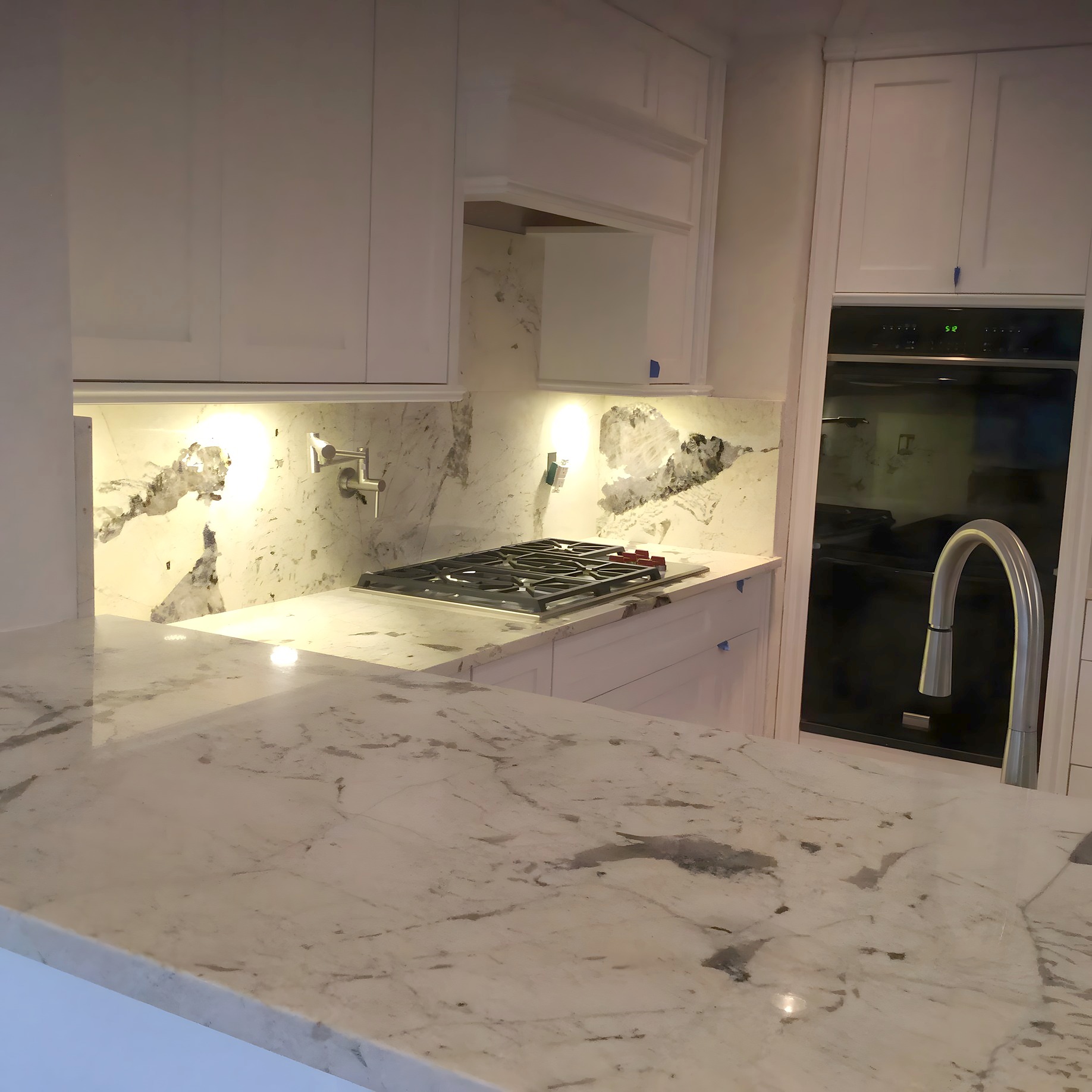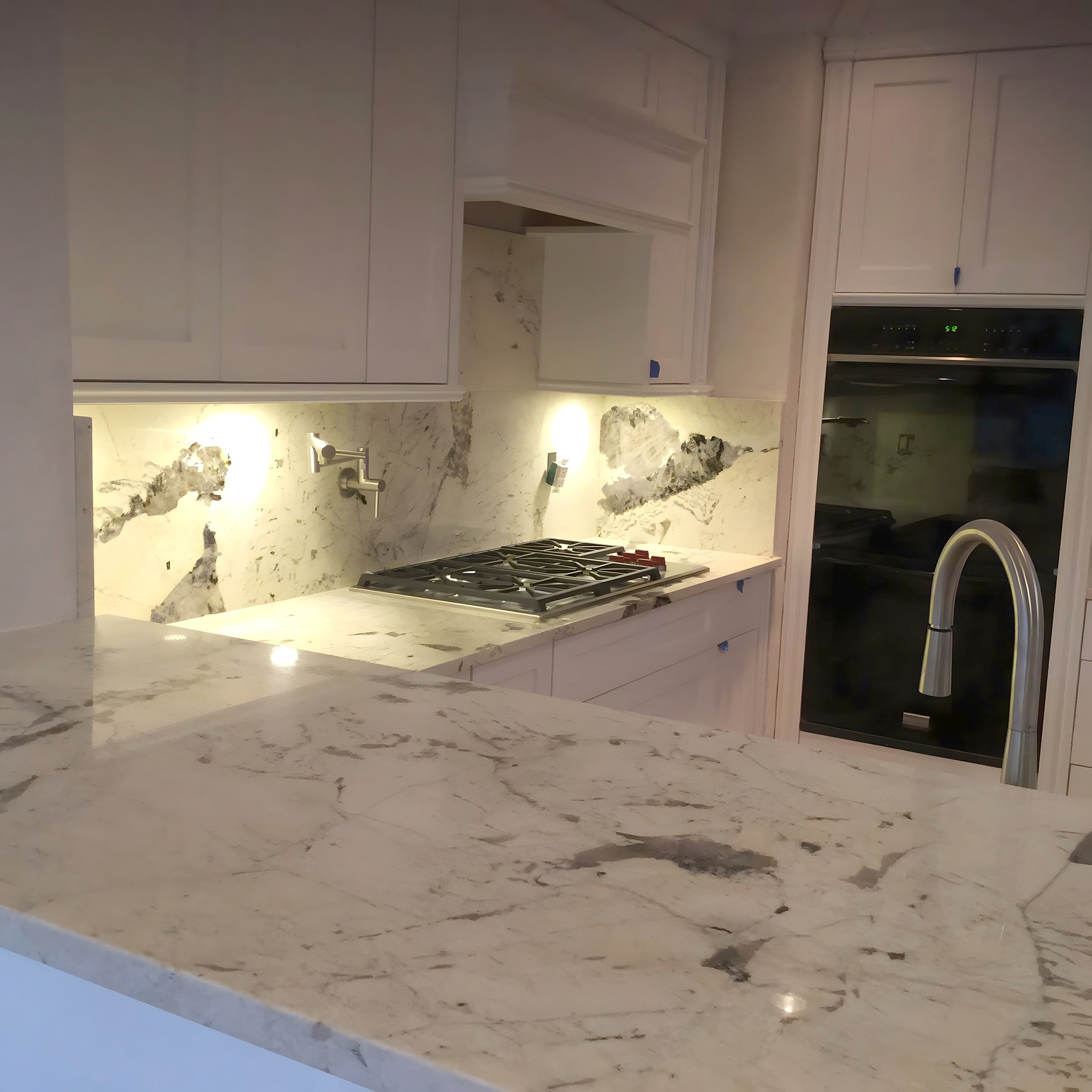
When homeowners hear "porcelain countertops," most picture bathroom floor tile glued to a piece of plywood. That's not what we're talking about. The porcelain countertops revolutionizing kitchen and outdoor design in South Florida are large-format sintered stone slabs — engineered surfaces created by fusing raw materials at extreme temperatures and pressures to produce something entirely different from traditional porcelain tile.
Understanding the pros and cons of porcelain countertops is essential before committing to this material, because sintered stone occupies a unique position in the countertop market. It does things no natural stone can do, but it has limitations that matter. After installing sintered stone surfaces across Miami, Hialeah, Fort Lauderdale, and the rest of South Florida for years, here's our complete, honest assessment.
What Is Sintered Stone? (It's Not Porcelain Tile)
This distinction is critical, so let's be clear about it.
Traditional porcelain tile is a ceramic product fired at high temperatures, typically 12x12 or 12x24 inches, designed for floors and walls. It's thin, it has grout lines, and it's not suitable as a countertop surface.
Sintered stone (sold under brands like Dekton by Cosentino, Lapitec, Neolith, and Laminam) is manufactured using a process called sintering — raw materials including glass, porcelain, quartz, and other minerals are subjected to extreme heat (over 2,000 degrees Fahrenheit) and massive pressure (approximately 25,000 tons) to fuse into a dense, non-porous slab. The result is available in full countertop-size slabs (up to 126 x 56 inches for Dekton, for example) and can be fabricated using the same CNC equipment we use for granite, marble, and quartz.
Think of the relationship between porcelain tile and sintered stone like the relationship between a brick and structural steel — same general material family, completely different product.
The Pros: Where Sintered Stone Excels
UV Stability — The Outdoor Game-Changer
This is the single biggest advantage sintered stone has over every other countertop material, and it's why South Florida is one of the best markets for it in the country.
Natural stone (granite, marble, quartzite) can handle some sun exposure, but prolonged UV radiation can alter colors over years. Quartz countertops — the engineered variety made with resins — are not UV-stable at all. Direct sunlight causes quartz to yellow, fade, and discolor, sometimes within months. This is why quartz manufacturers explicitly exclude outdoor use from their warranties.
Sintered stone is completely UV-stable. It will not fade, yellow, or change color under constant sun exposure. This makes it the clear choice for:
- Outdoor kitchens — extremely popular in South Florida, where outdoor living spaces are used year-round
- Pool areas — bar tops, serving counters, and outdoor dining surfaces exposed to constant sun
- Sunroom and Florida room counters — spaces with walls of glass that flood surfaces with UV light
- Window-adjacent kitchen counters — in South Florida homes with large west-facing windows, even indoor quartz can yellow over time
If you're building an outdoor kitchen anywhere from Miami to Fort Lauderdale, sintered stone should be at the top of your material list.
Waterproof and Humidity-Proof
Sintered stone has zero water absorption — technically measured at less than 0.1%, which is functionally zero. For context:
- Granite absorbs approximately 0.2-0.5% water
- Marble absorbs approximately 0.5-2% water
- Quartz absorbs approximately 0.02-0.05% water
- Sintered stone absorbs less than 0.1% water
In practical terms, this means sintered stone never needs sealing. Moisture from Florida's humidity cannot penetrate the surface. Mold and mildew cannot establish themselves in the material. There is no maintenance schedule to forget, no annual sealing appointment, and no risk of moisture damage.
For South Florida homeowners who want the absolute lowest maintenance countertop — even lower than quartz — sintered stone delivers. This makes it an excellent option for bathrooms as well as kitchens.
Heat Resistance
Sintered stone was created at over 2,000 degrees Fahrenheit. A hot pan from your stove (around 400-500 degrees) is not going to damage it.
You can place hot pots, pans, baking sheets, and even a hot flat iron directly on sintered stone without any risk of scorching, discoloration, or thermal shock cracking. No trivet needed — although we still recommend using one out of good habit.
For comparison:
- Quartz can be damaged by hot pans — the resin binders can scorch or discolor
- Marble can handle moderate heat but is vulnerable to thermal shock (sudden temperature changes)
- Granite handles heat well but can crack under extreme thermal shock
- Sintered stone is essentially immune to heat damage from normal kitchen use
Scratch and Stain Resistance
Sintered stone scores 7-8 on the Mohs hardness scale (granite is typically 6-7, marble is 3-4). It resists scratching from kitchen knives, abrasive cleaners, and everyday wear.
It's also highly stain-resistant. Red wine, coffee, turmeric, lemon juice, vinegar — the substances that stain or etch marble — sit on the surface of sintered stone without penetrating or reacting. You can clean them up with water and a cloth. No special cleaners needed, no panic when someone spills red wine.
Large Format, Minimal Seams
Sintered stone slabs are available in sizes up to approximately 126 x 56 inches (depending on the manufacturer and thickness). For many kitchens, this means fewer seams — or no seams at all. Fewer seams means a cleaner look and fewer potential maintenance points.
Design Versatility
Modern sintered stone is available in finishes that convincingly replicate marble, concrete, rust, wood, and abstract patterns. The surface can be polished, matte, textured, or brushed. For homeowners who want a marble look without marble's maintenance — especially outdoors — sintered stone offers remarkably convincing options.
The Cons: Where Sintered Stone Falls Short
No material is perfect, and sintered stone has real limitations that you should understand before committing.
Chipping at the Edges
This is the most significant practical concern with sintered stone. Because it's extremely hard, it can be brittle at the edges — particularly at thin edges and corners. A heavy cast-iron pan dropped on the edge of a sintered stone countertop can chip it in a way that granite or quartz would absorb without damage.
Mitigation: Choose a thicker slab (20mm or 30mm rather than 12mm), and consider a slightly rounded edge profile rather than a sharp eased edge. Mitered edges on sintered stone require an experienced fabricator — this is not a material for shops that are learning as they go.
Fabrication Requires Specialized Equipment and Experience
Not every stone fabricator is equipped to work with sintered stone. The material requires specific blade types, cutting speeds, and handling techniques. An inexperienced fabricator can crack a slab during cutting, create rough edges, or produce poor seam quality.
What this means for you: Ask your fabricator specifically about their experience with sintered stone. How many slabs have they fabricated? Do they have the right equipment? Can they show you completed sintered stone projects? This is one of the most important questions to ask your fabricator before signing a contract.
Limited Edge Profile Options
Because sintered stone is harder and more brittle than granite or marble, complex edge profiles (ogee, dupont, triple pencil) are more difficult to execute and more prone to chipping. Most fabricators recommend simpler edge profiles — eased, beveled, or bullnose — for sintered stone countertops.
If you have your heart set on an elaborate decorative edge, natural stone or quartz will give you more options.
Thinner Appearance
Sintered stone is commonly available in 12mm (about 1/2 inch) and 20mm (about 3/4 inch) thicknesses. While 30mm (about 1-1/4 inch) is available, it's less common and more expensive than comparable thicknesses in quartz or granite. The thinner profile looks distinctly modern — which is a pro or a con depending on your design preference.
For a traditional kitchen that calls for a thick, substantial countertop edge, sintered stone's thinner slabs may not deliver the visual weight you want. Mitered edges can create a thicker appearance, but as noted above, this requires expert fabrication.
Repair Difficulty
If sintered stone chips or cracks, repair is more difficult than with natural stone. Granite and marble chips can be filled with color-matched epoxy and polished to be nearly invisible. Sintered stone repairs are possible but tend to be more visible, particularly on textured or matte finishes.
When Sintered Stone Beats Natural Stone
Based on our experience across hundreds of South Florida installations, sintered stone is the best choice when:
- The countertop will be outdoors or in direct sunlight. No other countertop material matches its UV stability
- You want the absolute lowest maintenance possible. Even lower than quartz — no sealing, no special cleaners, no restrictions on what you can place on the surface
- You want a marble look outdoors. Marble itself won't last outdoors in Florida (rain, sun, and humidity will destroy it). Sintered stone with a marble pattern gives you the look with none of the vulnerability
- You want a modern, thin-edge design. Sintered stone's 12mm and 20mm profiles suit contemporary and minimalist kitchens perfectly
- You prioritize heat resistance. If you regularly cook with heavy cast iron or bake at high temperatures, sintered stone's heat immunity is genuinely liberating
When Natural Stone or Quartz Is the Better Choice
Sintered stone isn't the right material for every project:
- If you want maximum edge profile options, choose granite, marble, or quartz
- If you want the character and depth of real natural stone, nothing replicates it exactly. Sintered stone can imitate marble, but up close, a real Calacatta slab has depth and translucency that an engineered surface can't fully match
- If your kitchen style is traditional or classic, the thicker profiles and ornate edges of natural stone may suit the design better
- If repairability is a priority, natural stone is easier to repair if damaged
Choosing a Fabricator for Sintered Stone
We cannot stress this enough: sintered stone fabrication requires specific expertise. The material behaves differently from natural stone and quartz during cutting, edging, and installation. An experienced fabricator will know the right blade speeds, support techniques for thin slabs, and adhesive systems for seaming.
At Becca Proworks, we fabricate Dekton, Neolith, and other sintered stone brands in-house using equipment specifically calibrated for these materials. If you're considering sintered stone for your kitchen, bathroom, or outdoor space in South Florida, request an estimate and we'll walk you through the options.
The Bottom Line
Sintered stone is not a replacement for natural stone — it's a different category entirely. It solves specific problems (UV exposure, zero maintenance, extreme heat resistance) better than any other material on the market, while accepting trade-offs in edge versatility and repairability.
For South Florida specifically, where outdoor kitchens are a lifestyle essential and humidity is a year-round reality, sintered stone has earned its place as a top-tier countertop material. It's not right for every project, but when it's right, nothing else comes close.
Want to see sintered stone in person? Call (786) 468-5078 or visit our slab yard to view full-size slabs in Dekton, Neolith, and other sintered stone brands. We'll help you determine whether sintered stone — or another material — is the best fit for your project.
Browse our completed projects to see sintered stone installations alongside natural stone and quartz across Miami, Fort Lauderdale, and Coral Gables.